

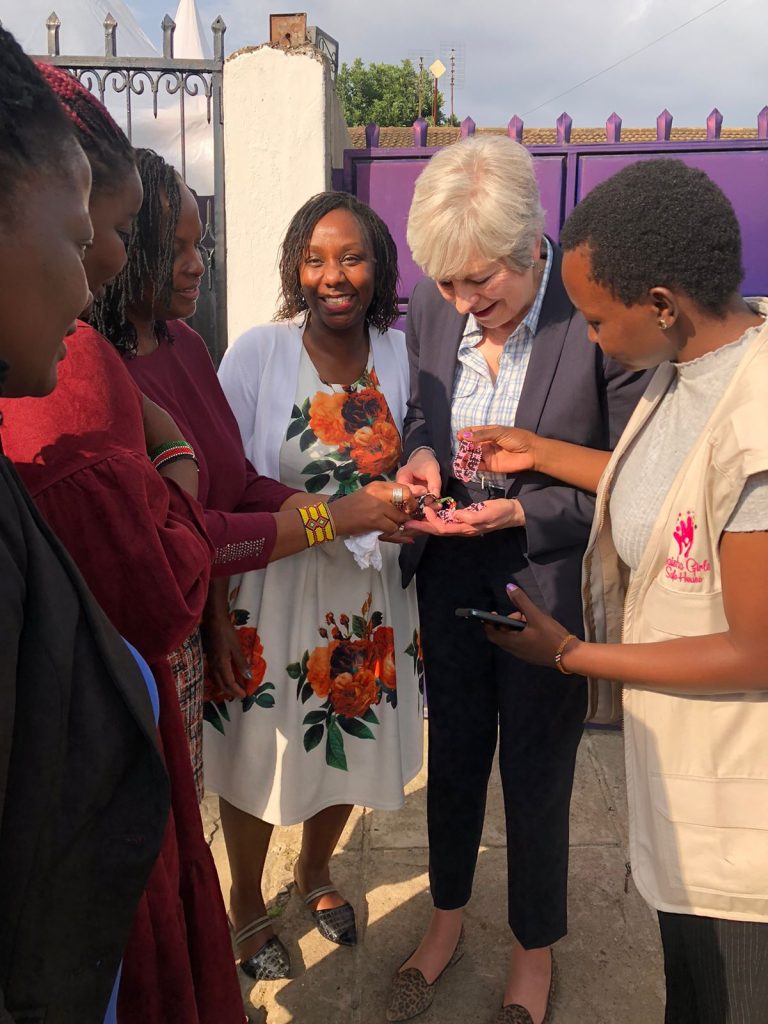
Maisha Girls Safe House was honoured to host the Global Commission on Modern Slavery and Human Trafficking, led by former UK Prime Minister Rt Hon Theresa May, during their visit to Kenya. This significant engagement highlighted the global relevance of our work and the urgent need to protect and empower young survivors of human trafficking and sexual violence.
During their visit, the Commissioners toured our facilities and spent time with the girls in our care, listening directly to their stories. In these conversations, survivors courageously shared their lived experiences, reflecting on the realities they face beyond policy frameworks. Some spoke candidly about how legal protections and policy commitments do not always translate into safety, justice, or meaningful support on the ground, highlighting the persistent gap between legislation and lived experience.
In discussions with the Maisha team, the Commission engaged on the systemic challenges that continue to hinder survivor recovery and justice. These included limited access to legal aid, inadequate and inconsistent funding for safe houses, and the critical need to center survivor voices in policy development and advocacy efforts. Commission members emphasized that ending modern slavery requires more than strong statements, it demands sustained political will, international cooperation, survivor-led approaches, and community-driven solutions.
The visit formed part of the Commission’s broader regional engagement across Africa, where they met with government officials and civil society organizations to examine how poverty, inequality, weak protection systems, and social injustice continue to fuel modern slavery and human trafficking. Their work reinforced an important truth: exploitation is not only a local or national issue, it is deeply connected to global economic and social structures.
This engagement came at a particularly critical moment for Kenya. According to the Global Slavery Index, an estimated 269,000 people in Kenya are living in situations of modern slavery, a stark reminder of the scale and urgency of the challenge we face (Global Slavery Index – Kenya Snapshot). By spotlighting the work of Maisha Girls Safe House, the Commission helped amplify the call for stronger systems, greater accountability, and survivor-centered reforms.
This visit reaffirmed our shared commitment to ending human trafficking and modern slavery requires listening to survivors, advocating boldly, and building partnerships that lead to tangible change. At Maisha, we remain committed to transforming survivor voices into action while working alongside communities, policymakers, and global allies to ensure that protection, dignity, and justice are not promises, but realities for every survivor.