

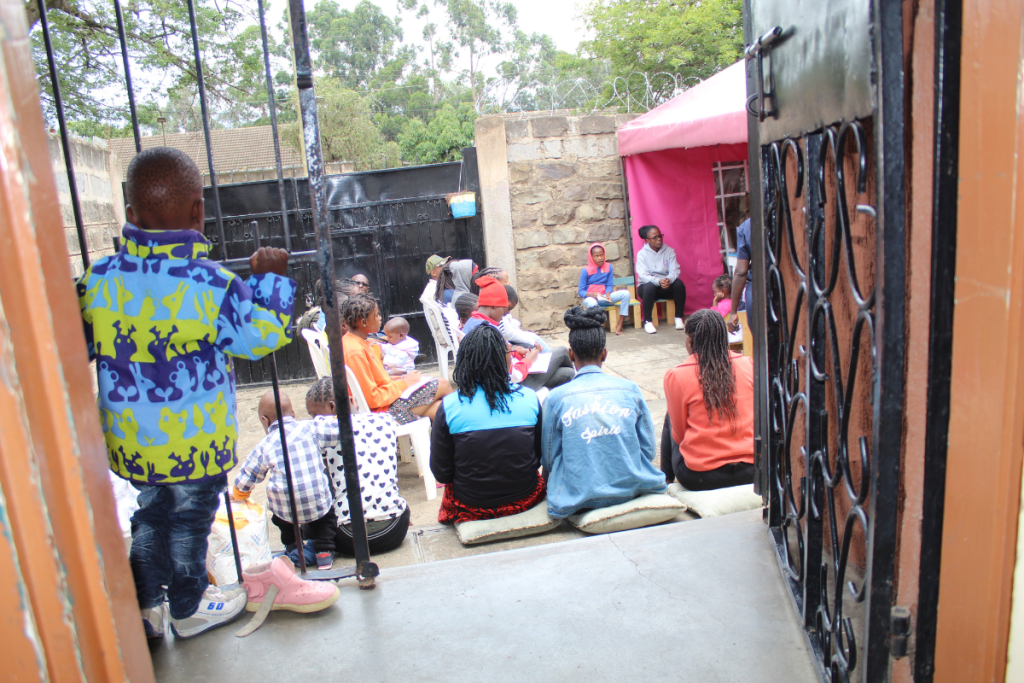
On 5 June 2025, in collaboration with Bashosho Talents from Kiambiu, Maisha Girls Safe House conducted a magnet theatre session in Viwandani, reaching community members in St. Elizabeth and Corner Villages. The activity was designed to raise awareness on sexual and gender-based violence (SGBV) and to foster community engagement using interactive, surprise public performances that encourage reflection and dialogue. Approximately 180 community members participated across the two locations, witnessing and interacting with the performances.
The first scene focused on domestic violence. The session began with vibrant songs that attracted a crowd, and Bashosho Talents staged a realistic domestic dispute. A male actor physically assaulted a female actor, creating the impression of a genuine incident, while other actors disguised as passersby intervened to model positive community responses. Following the dramatization, facilitators engaged the crowd in discussions about the realities and dangers of domestic violence, safe ways to intervene or report incidents, the importance of protecting survivors without victim-blaming, and the referral pathways and services available to survivors. At the end of the discussion, it was revealed that the scene was staged, reinforcing the learning safely.
The second scene, performed at the alternate location within Viwandani, addressed street harassment. The performance depicted a woman arriving on a motorcycle who was harassed by two young men, while team members intervened to protect her, demonstrating bystander responsibility and the importance of challenging the normalization of harassment. Following the performance, community members engaged in discussions on street harassment as a form of SGBV, women and girls’ rights to move safely, legal protections and consequences, and community-based referral mechanisms. The realism of the performance prompted strong emotional responses, with some members of the public attempting to intervene physically, believing the scenario was real.
Throughout the sessions, facilitators employed visual aids, interactive discussions, and participatory engagement, ensuring that community members could absorb the lessons and relate them to their daily lives. The magnet theatre approach provided a safe yet impactful entry point for dialogue on sensitive issues, sparking reflection, awareness, and community accountability.
The activity achieved several outcomes: it raised awareness on SGBV, demonstrated the power of positive bystander intervention, and strengthened community understanding of referral pathways for survivors. It also empowered participants to recognize their role in creating safer environments and highlighted the value of innovative approaches, like interactive theatre, in breaking the silence around SGBV and fostering protective communities.